Taoyuan A8 Deal Notes (3)|Chenlu Technology: AI Dual-Lens Endoscope, SaMD First, Then Single-Use Scopes
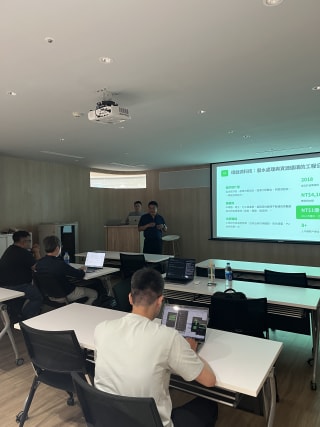
NTUTEC invited us to Taoyuan A8. Third stop, Chenlu Technology: AI-assisted medical endoscopy, IRB cleared at Tri-Service General Hospital, TFDA under review, and the overall maturity the A8 cohort showed.
In one sentence
Use SaMD software to enter the hospital workflow and collect the first revenue, then scale up with single-use scopes. IRB cleared at Tri-Service General Hospital, TFDA under review. Of the four companies, this is the one that lined up product, regulation, and business model most neatly.
Core claims
- The pain point is concrete: colonoscopy misses lesions, and AI dual-lens same-frame comparison is there to cover that missed glance.
- They thought the order through: software enters first (lower threshold, faster feedback), consumables scale later (volume, recurring). Easier for a VC to model.
- Regulatory progress means it is not a concept deck: IRB passed, TFDA under review. They talk timelines, not visions.
- They know the clinic is not only about the algorithm: they went out of their way to say the network cannot be intermittent. Only people who have actually been in the field say that.
Why I am writing this one up
Following (1) Ruomei and (2) EITH, the third company of the same session, part three of four: Chenlu Technology Co., Ltd.
Ruomei leaned toward materials, EITH toward wastewater resource recovery. This one is an AI-assisted medical endoscopy system. With the previous company I started lagging in the second half. This one was easy to follow throughout: one line from pain point to revenue, with no detours in the middle.
What Chenlu does
In plain language: while examining with a colonoscope, use AI dual lenses to compare white light and NBI-like imaging in the same frame, mark suspicious spots in real time, and produce a presentation-grade report, so doctors miss less.
Core technology (from the room and public sources)
- AI dual-lens medical endoscopy assistance system
- White light plus NBI-like imaging in the same frame: two imaging modes compared in one view to help assess lesions
- AI marks possible lesions and generates a briefing or report (patent applied for)
- Single-use disposable scope: lowers cross-infection and cleaning cost, in line with infection control trends
- Online and cloud capability matters: they specifically said the network has to be stable and cannot be intermittent, so imaging and AI inference keep up with clinical rhythm
Their public website also mentions a 12 mm single-use dual-lens design, three-view synchronization, and real-time deep learning annotation, broadly consistent with the room.
Competition and differentiation
Competitors named in the room include Olympus, Ambu, and GI View. Some of them run a reusable route, while Chenlu emphasizes single-use scope plus AI assistance, differentiating on both infection control and real-time annotation.
Regulatory and clinical progress
| Item | What they said |
|---|---|
| IRB | IRB validation completed at Tri-Service General Hospital |
| TFDA | Under review (from the room; public sources also show an FDA 510(k) direction) |
| Team | Medical advisors and medical device advisors on the team |
For a MedTech startup, this is not a concept deck. They are already at clinical validation moving into regulatory review, and the rhythm looks like actually pushing a product to market.
Business model: SaMD first, then single-use scopes
The go-to-market they described has two stages, and I thought this part of the pitch was very clear:
-
First create revenue with SaMD (Software as a Medical Device)
AI-assisted reading and report generation can enter the hospital workflow first, with a relatively low threshold and a fast feedback loop. -
Then lift revenue with single-use scopes
Hardware consumables run on volume, and disposable use lowers contamination concerns, forming a software plus consumables recurring structure.
First-year targets (from the room)
- Demonstration hospitals: about 1 to 2
- Volume: roughly 50 to 80 scopes per hospital
- Overseas: aiming at Southeast Asian distribution later
Company status (checked against public records)
- Legal name: Chenlu Technology Co., Ltd.
- CEO: Fang Yuan-ting (public sources)
- Base: Guishan District, Taoyuan (public sources place it around Fuxing Street)
- Website: chenlukejigufenyouxiangongsi8.webnode.page
- Public materials also describe two lines, human colonoscopy and veterinary endoscopy; the A8 session focused on human AI assistance
TFDA under review, IRB passed, and the first-year demonstration hospitals and scope counts all came from the room, and can be corrected later against publishable figures.
What this one left me with
- The product story is complete: pain point (missed lesions) → technology (dual lens plus AI) → differentiation (single-use plus SaMD) → competitive comparison, told as one line.
- Regulation has progress: Tri-Service IRB, TFDA under review, not stuck at prototype.
- The model is staged: SaMD collects money first, scopes scale later, which makes the path easier for a VC to calculate.
- Infrastructure awareness: stressing network stability means they know the clinical floor is not just about a pretty algorithm.
Overall takeaway from this A8 session (after all four)
Ruomei, EITH, Chenlu, AWAREK: four completely different fields (cooling materials, wastewater resource recovery, medical endoscopy, thermal imaging AIoT), but they share one thing: this A8 cohort is mature across the board.
It is not just polished decks. Most of them could speak to product, customers, regulation, or a financial path. Some are already talking IPO and global distribution, some still need to fix their pitch rhythm, but underneath they all look like they are building an industrial business or heading for listing, not brainstorming a concept.
For someone bringing a team to look at deals, what is worth remembering is not only the individual companies, but what the spread of maturity, and the shared vocabulary, look like within one venue (product, numbers, regulation, exit, cap table). For example VCs often hesitate at a 51:49 split, while a configuration like 7:3 with a clearer lead is easier to negotiate. Details are in (2) EITH’s pitch notes. The fourth company, AWAREK, is in (4).
Taoyuan A8 deal notes (four companies)
- (1) Ruomei Technology: AI cooling burns cash, so start from radiation on the materials side
- (2) EITH: turning wastewater into resources, and making a pitch non-experts can follow
- (3) Chenlu Technology: AI dual-lens endoscope, SaMD first, then single-use scopes
- (4) AWAREK: sensor fusion thermal imaging, partnering with tender-bidding SIs